


Panch Kedar Temples, Yatra, Trek, Map & Packages in Uttarakhand
Close your eyes and picture this: it’s 5 in the morning, somewhere deep in the Garhwal Himalayas. The air smells of pine, wet rock, and incense drifting from a temple that has stood here longer than memory. A priest chants in the darkness. Above you, snow peaks glow faint orange in the first light. You’re not on a holiday. You’re on a pilgrimage.
This is what the panch kedar circuit does to you. It doesn’t just show you five extraordinary temples — it changes something inside you.
The panch kedar temples are five sacred Shiva shrines scattered across the high ranges of Uttarakhand, each perched between 2,200 and 3,900 metres above sea level. Together, they form one of the most spiritually intense and physically demanding pilgrimage circuits in all of India. Whether you’re a devout pilgrim, a seasoned trekker, or someone searching for something you can’t quite name yet — Panch Kedar will find you.
In this guide, you’ll get everything: the mythology, the temples one by one, the route map, the best time to visit, trekking tips, what to look for in a package, and honest advice from people who walk these trails every season.
What is Panch Kedar? History & Mythology
Every trail in the Himalayas carries a story. But few carry one as old or as moving as the legend behind the panch kedar.
After the great war of Kurukshetra, the Pandavas were wracked with guilt. They had killed their own cousins — Kshatriyas, their kinsmen. The weight of that sin could only be washed clean by the blessings of Lord Shiva. So they came to Uttarakhand, to the high mountains, searching for him.
But Shiva didn’t want to be found. Not yet.
He disguised himself as a bull and vanished into the earth — but not all at once. His body parts appeared at five different locations across the Garhwal Himalayas. The hump emerged at Kedarnath. The navel at Madhyamaheshwar. The arms at Tungnath. The face at Rudranath. And the matted locks of hair, the jata, at Kalpeshwar.
The Pandavas, recognising the divine in each of these forms, built temples at each spot. And so the panch kedar temple circuit was born — five sacred points of a single divine body, spread across five peaks, five valleys, five worlds.
This isn’t mythology kept behind glass in a museum. Up here, it breathes. You feel it when you cross a snowfield at 3,600 metres, or when a local priest offers you prasad with hands that have done the same thing every morning of his life.
The Five Panch Kedar Temples (With Details of Each)
1. Kedarnath Temple — The Crown of Panch Kedar
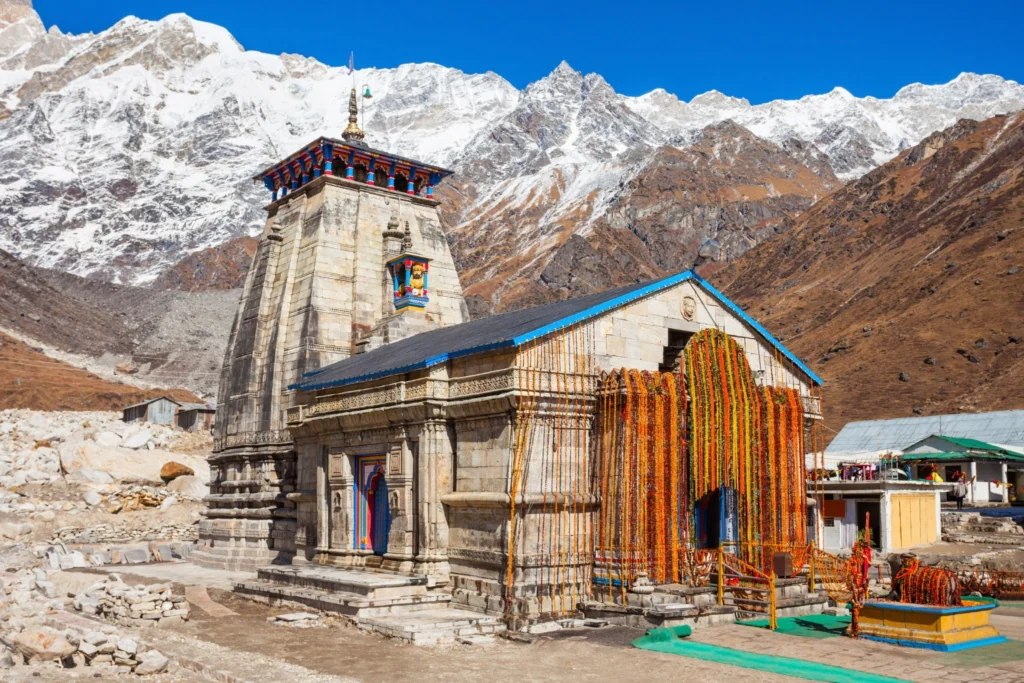
Location: Rudraprayag district, Uttarakhand Altitude: 3,583 metres Nearest base village: Gaurikund What it represents: The hump (prishth bhag) of the divine bull
Kedarnath needs no introduction — it is the most visited of the five, and arguably the most famous Shiva temple in the country. Backed by the towering Kedarnath peak and flanked by glaciers, this ancient stone temple dates back over 1,000 years, rebuilt by Adi Shankaracharya in the 8th century CE. The panch kedar yatra for most pilgrims begins right here.
Trek: 16 km from Gaurikund (also accessible by helicopter) Difficulty: Moderate Opening dates 2025: Late April (announced by the Char Dham Devasthanam Board) Closing dates: November (after Diwali, the deity’s doli is carried to Ukhimath)
What makes it special: the sheer drama of the setting. No photograph prepares you for standing in front of that stone temple with a glacier behind it.
2. Madhyamaheshwar Temple — The Navel of the Himalayas
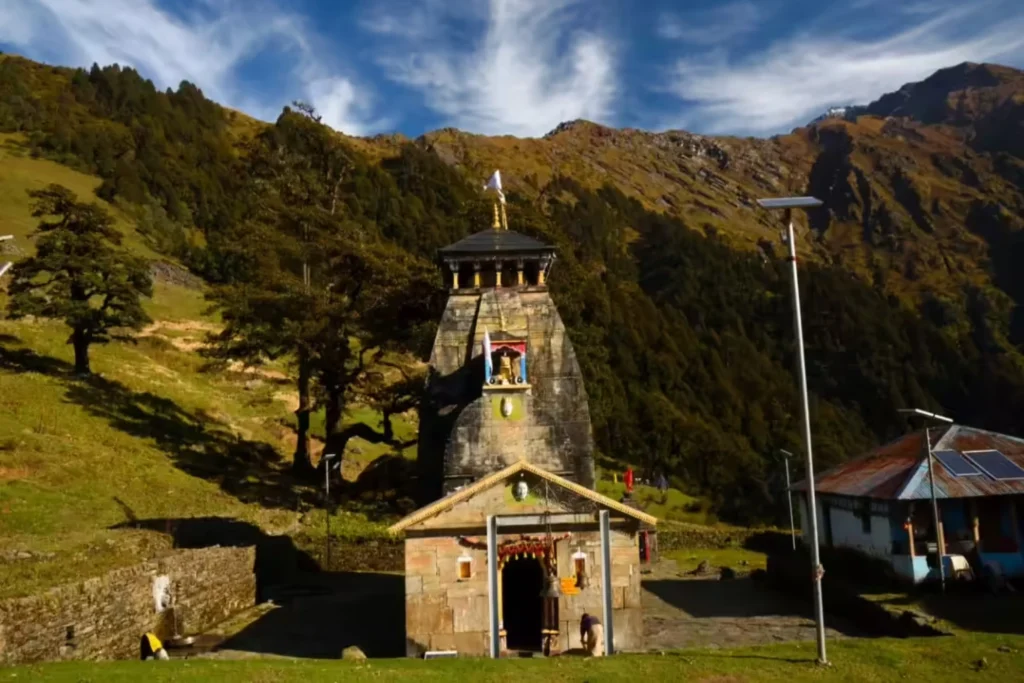
Location: Rudraprayag district, above Ukhimath Altitude: 3,497 metres Nearest base village: Ransi (via Ukhimath) What it represents: The navel (nabhi) of the divine bull
If Kedarnath is the crown of the Panch Kedar, Madhyamaheshwar is its heart.
The madhyamaheshwar temple sits in a meadow so beautiful it feels imagined. The Chaukhamba massif — four peaks rising over 7,000 metres — fills the entire horizon behind the temple in a way that makes you stop walking mid-step and just stare. It’s the kind of view that doesn’t feel real until you’ve been there, and then you can’t stop thinking about it.
The trail to Madhyamaheshwar passes through dense rhododendron forests, open bugyals (alpine meadows), and small shepherd camps. In May and June, those bugyals burst with wildflowers. In September and October, the skies clear to a sharp, cold blue and the views are unbeatable.
The temple itself is modest in structure but enormous in presence. The nabhi (navel) of Shiva is worshipped here in the form of a naturally formed stone. The priests are local Garhwalis, many from Ukhimath village itself, and their warmth and knowledge of the tradition adds a dimension you simply won’t find at more commercialised pilgrim sites.
What makes Madhyamaheshwar genuinely different from the other four Kedars is the sense of intimacy. There are no helicopters here. No motorable roads come close. Every person you meet has walked the same path, carried the same devotion on the same legs. That shared effort creates a rare community — strangers who feel like they’ve known each other for miles.
The upper meadow above the temple, called Budha Madhyamaheshwar, is a 3 km further climb to 3,800 metres. On a clear morning, you’ll see Kedarnath, Kedar Dome, Chaukhamba, Neelkanth, and Trishul — an unbroken panorama of some of the mightiest peaks in the Garhwal Himalayas. Serious trekkers don’t skip it.
Trek: 24 km from Ransi village (2–3 days, moderate trail) Difficulty: Moderate Opening dates 2025: Early May (confirmed by local pujari calendar) Closing dates: November (Kartik Purnima)
In my experience guiding groups to Madhyamaheshwar, first-timers are almost always surprised — they come expecting a tough pilgrimage, and they leave having had one of the best experiences of their lives. The trail is challenging enough to feel earned, but manageable enough for anyone with reasonable fitness. It hits the sweet spot perfectly.
Our team at Madmaheshwar Trek is based in Ukhimath — the gateway village for the Madhyamaheshwar Trek. If you’re planning this trek, we can take care of everything from the moment you arrive in Ukhimath.
3. Tungnath Temple — The Highest Shiva Temple
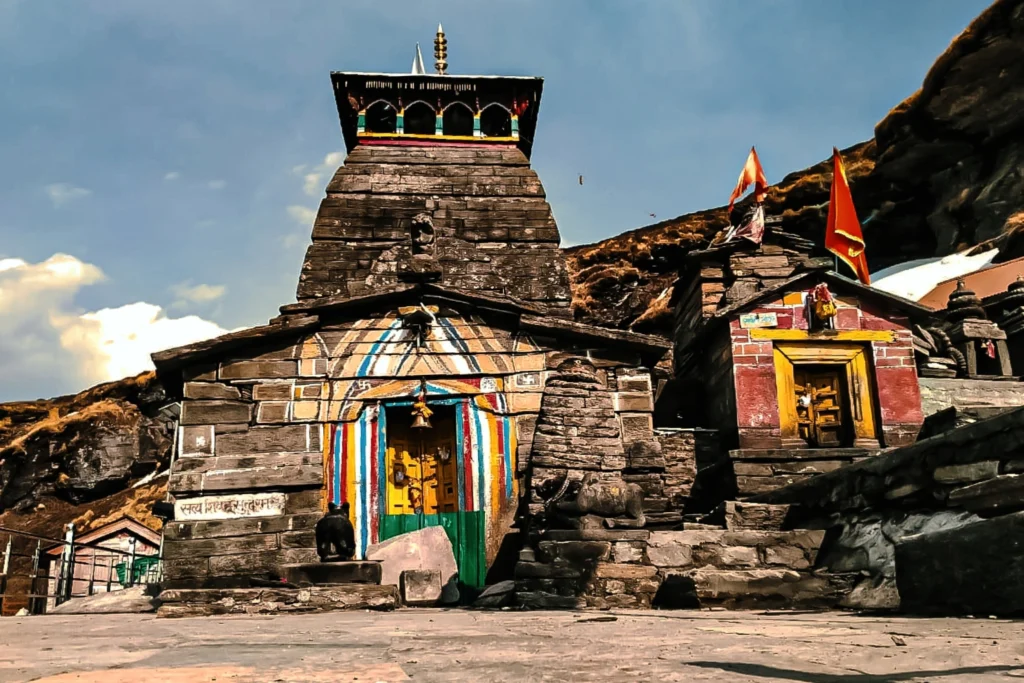
Location: Rudraprayag district, above Chopta Altitude: 3,680 metres (the highest Shiva temple in the world) Nearest base village: Chopta What it represents: The arms (bahu) of the divine bull
Tungnath holds a record no other temple in the world can claim: it is the highest Shiva shrine on the planet. The trek from Chopta is just 3.5 km — making it the shortest and most accessible of all the Panch Kedar temples.
But don’t let the easy access fool you. The views from the ridge above Tungnath — and especially from the nearby peak of Chandrashila at 4,130 metres — are among the finest in Uttarakhand.
Trek: 3.5 km from Chopta Difficulty: Easy to Moderate Opening dates 2025: May Closing dates: November
Chopta itself, often called the “Mini Switzerland of Uttarakhand,” is worth a night’s stay for the stargazing alone.
4. Rudranath Temple — The Face of Shiva
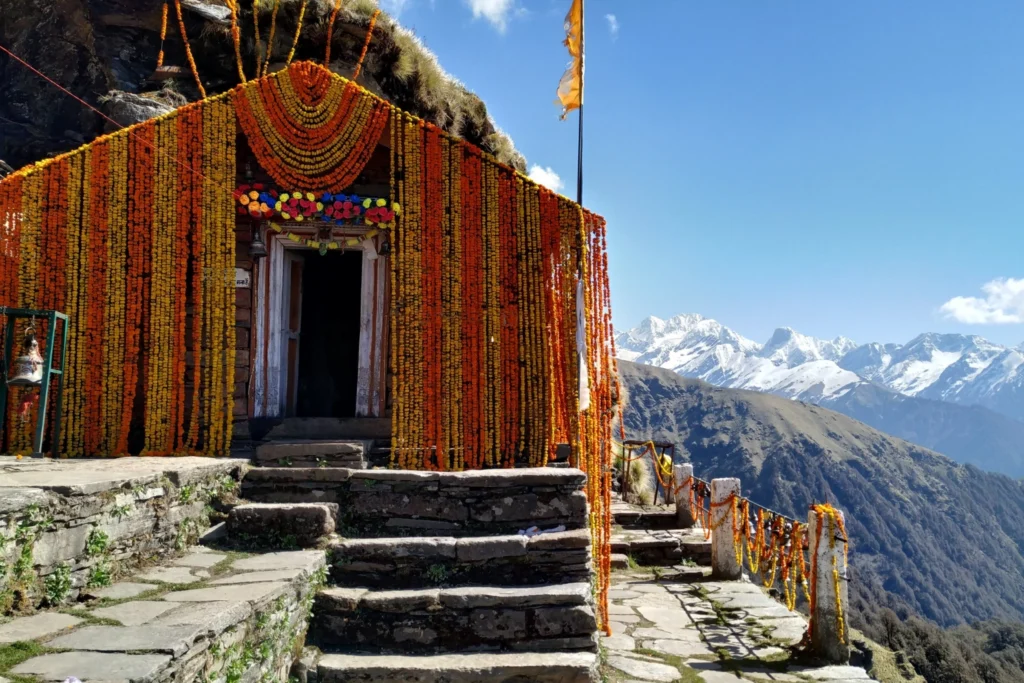
Location: Chamoli district, above Gopeshwar Altitude: 3,600 metres Nearest base village: Sagar village / Mandal What it represents: The face (mukha) of the divine bull
Rudranath is the wild one. The trail to reach it passes through thick oak and rhododendron forests, past Apsara Kund (a stunningly clear glacial lake), and through remote meadows that feel entirely untouched.
Here’s what most guides won’t tell you: the forest section of the Rudranath trail is one of the most beautiful in all of Uttarakhand. It gets less attention than Kedarnath or Tungnath, which means fewer crowds and a far more intimate experience.
Trek: 20 km from Sagar village (2–3 days) Difficulty: Moderate to Hard Opening dates 2025: May Closing dates: November
5. Kalpeshwar Temple — The Only Year-Round Kedar
Location: Chamoli district, Urgam Valley Altitude: 2,200 metres Nearest base village: Urgam What it represents: The matted hair (jata) of Shiva
Kalpeshwar is unique in two ways: it is the lowest of the five temples, and the only one that remains open throughout the year — even in winter when the other four are snowed in and their deities relocated to valley temples.
The approach is a short and pleasant walk through the Urgam Valley. A natural cave leads to the main shrine, which adds a mysterious, ancient quality that the other temples don’t quite replicate.
Trek: 1 km easy walk from Urgam Difficulty: Easy Open: Year-round
Panch Kedar Map — Route & Geography
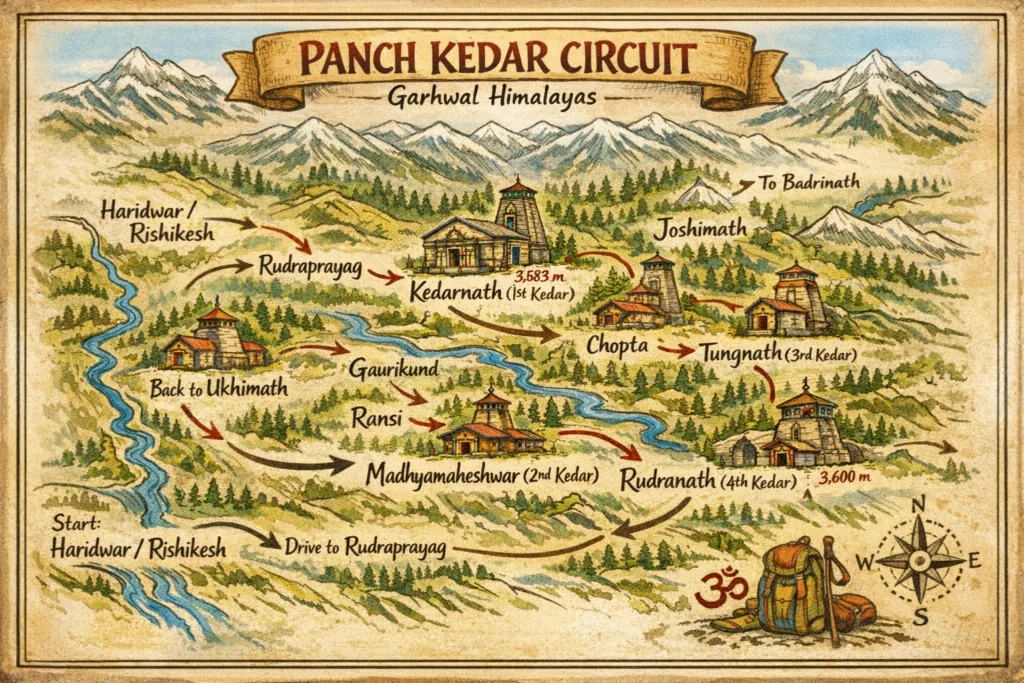
The five temples are scattered across the rugged Garhwal Himalayas in Uttarakhand, spanning three districts: Rudraprayag, Chamoli, and the area around Ukhimath.
[IMAGE SUGGESTION: Hand-drawn style map of Panch Kedar circuit route across Garhwal Himalayas]
Understanding the panch kedar map helps you plan far more efficiently. Here is how the geography sits:
Most pilgrims and trekkers enter the circuit from Rishikesh or Haridwar, which are well-connected to the rest of India by road and rail. From there, the panch kedar route typically flows like this:
- Haridwar / Rishikesh → drive to Rudraprayag
- Rudraprayag → Gaurikund → Kedarnath (1st Kedar)
- Back to Ukhimath → Ransi → Madhyamaheshwar (2nd Kedar)
- Ukhimath → Chopta → Tungnath (3rd Kedar)
- Gopeshwar → Sagar / Mandal → Rudranath (4th Kedar)
- Joshimath → Urgam Valley → Kalpeshwar (5th Kedar)
The key junction towns you’ll pass through are Rudraprayag, Ukhimath, Gopeshwar, and Joshimath. Each has accommodation, local food, and connections to the respective temples.
The panch kedar distance varies significantly from one temple to the next — from a 1 km stroll at Kalpeshwar to a 24 km full trek at Madhyamaheshwar. Planning your buffer days accordingly makes or breaks the trip.
For the Madhyamaheshwar section of the panch kedar route, our team at Madmaheshwar Trek operates directly from Ukhimath — the gateway village to the second Kedar. We know every stone on that trail, and we’d love to be your guides for it.
Panch Kedar Yatra — Everything You Need to Know
Best Time to Do Panch Kedar Yatra (Month-by-Month)
The panch kedar yatra is a seasonal pilgrimage. The temples open in late April–early May and close in October–November.
|
Month |
Conditions |
Recommended? |
|
Late April – May |
Snow still on trails, cool, less crowded |
✅ Great for early birds |
|
June |
Rhododendrons in bloom, pleasant weather |
✅ Excellent |
|
July – August |
Monsoon rains, trail can be slippery |
⚠️ Doable but cautious |
|
September – October |
Clear skies, best mountain views, cool temps |
✅ Best time overall |
|
November |
Temples close, snow arrives |
❌ Most temples closed |
If mountain views matter most to you, September and October are the golden months. If you want wildflowers and a gentler trail, May and June are wonderful.
How Many Days Does Panch Kedar Yatra Take?
Doing all five temples in a single trip takes a minimum of 18–22 days if you’re doing them all on foot. Most people who complete the full circuit at a comfortable pace budget 3–4 weeks.
However, many visitors do one or two temples per trip — which is entirely legitimate. Kedarnath and Tungnath together make a solid 5–6 day trip. Adding Madhyamaheshwar to that creates a 10–12 day itinerary that covers three of the five Kedars beautifully.
Physical Fitness & Preparation Tips
You don’t need to be an athlete. But you do need honest preparation for the panch kedar yatra.
- Start walking 6–8 weeks before your trip. Daily walks of 45–60 minutes on inclines are the best preparation.
- Altitude adjustment is real. Don’t rush. Most issues happen when people try to climb too high, too fast.
- Consult a doctor if you have heart, lung, or blood pressure conditions.
- Drink at least 3 litres of water daily on the trail.
- Avoid alcohol for at least 48 hours before and during high-altitude sections.
Registration & Permits Required
For Kedarnath, biometric registration at Sonprayag/Gaurikund is compulsory. For other temples, no formal permit is required at the time of writing — but always confirm current requirements before your trip, as regulations can change season to season.
What to Pack for Panch Kedar Yatra
- Warm layers (temperature drops sharply above 3,000 metres)
- Rain jacket or poncho
- Sturdy trekking shoes with ankle support
- Sunscreen (UV is intense at altitude)
- Personal first aid kit including altitude sickness medication (Diamox — consult your doctor)
- A light but warm sleeping bag if camping
- Torch / headlamp
- Dry snacks and electrolyte sachets
Panch Kedar Trek — Difficulty, Trails & Tips
The panch kedar trek sits at a fascinating intersection: it is simultaneously a pilgrimage and a serious mountain adventure.
Here’s an honest difficulty breakdown:
|
Temple |
Trek Distance |
Difficulty |
|
Kedarnath |
16 km |
Moderate |
|
Madhyamaheshwar |
24 km |
Moderate |
|
Tungnath |
3.5 km |
Easy–Moderate |
|
Rudranath |
20 km |
Moderate–Hard |
|
Kalpeshwar |
1 km |
Easy |
The truth is, Madhyamaheshwar Trek offers the most satisfying balance for most trekkers — long enough to feel like a real expedition, manageable enough for first-timers with good fitness, and rewarded by the most jaw-dropping campsite views of the circuit.
Pro tips from a local guide’s perspective:
- Acclimatise before going high. Spend a night at an intermediate camp rather than rushing to the top.
- Start each day early. Mountain weather in Uttarakhand tends to deteriorate in the afternoon. Aim to reach your camp by 2 pm.
- Wear the right footwear. Sandals and casual trainers cause more evacuations on these trails than anything else. Proper trekking boots with ankle support are non-negotiable.
- Go slow on the first day. Slow and steady isn’t just a cliché in the Himalayas — it’s survival strategy.
- Don’t skip the upper meadows. At Madhyamaheshwar and Rudranath especially, the views from above the temple are worth every extra step.
If this is your first panch kedar trek, start with either Tungnath (shortest) or Madhyamaheshwar (most rewarding). Both are ideal entry points.
Panch Kedar Yatra Package — What to Look For & Our Recommendation
Before you book anything, let’s talk about what a genuinely good panch kedar yatra package actually looks like.
A quality package for the full circuit — or for individual temples — should include:
- Certified local guides who know the trail, speak both Hindi and adequate English, and understand altitude safety
- Transport from the nearest town (Rishikesh, Haridwar, or Dehradun) to the trailhead and back
- Accommodation in guesthouses or fixed camps along the route (clean, with blankets — not luxury, but dignified)
- All meals on the trail — hot breakfast, packed lunch, and dinner
- Permits and registrations handled on your behalf
- First aid kit and basic rescue support
Here’s what to watch out for: very cheap packages that don’t mention guide certification, skip meals, or use vague terms like “shared accommodation” without clarification. In the mountains, corners cut on safety cost more than money.
For the Madhyamaheshwar leg of your panch kedar yatra package, our team at Madmaheshwar Trek offers fully organised, locally led treks starting from ₹6,900 per person. We’re based in Ukhimath, the gateway village to the second Kedar — which means we’re not a travel agency sitting in Delhi managing this remotely. We live here. We will guide you here. And we care deeply about getting it right.
Our packages include certified local guides (many of whom have been on this trail for 15+ years), accommodation, all meals, and end-to-end support from Ukhimath.
Panch Kedar in Uttarakhand — Why This Circuit is Different from Char Dham
Most visitors to Uttarakhand know about the Char Dham circuit — Yamunotri, Gangotri, Kedarnath, and Badrinath. It’s a well-oiled pilgrimage machine with paved roads, helicopter services, and millions of visitors each season.
Panch Kedar in Uttarakhand is something else entirely.
Three of the five temples — Madhyamaheshwar, Rudranath, and Tungnath — are only reachable on foot. There are no helicopters ferrying crowds to these ridges. No roadside dhabas every half kilometre. What you find instead is a pilgrimage that demands something genuine from you.
The trails pass through villages where Garhwali culture is still very much alive — where shepherds drive their flocks across the same meadows their great-grandparents used, where local priests recite Sanskrit verses learned from their fathers, where the mountains haven’t been domesticated by development.
The crowds at Kedarnath can reach tens of thousands per day during peak season. At Madhyamaheshwar, on a September morning, you might share the meadow with twenty people. That ratio changes everything about how the place feels.
Panch kedar in uttarakhand isn’t a lesser version of Char Dham. It’s a rawer, deeper, more personal experience. For pilgrims and trekkers who want more than a checked box — this is the circuit that delivers.
Final Thoughts
The Panch Kedar circuit is not just a list of five temples to visit. It is a slow conversation with the Himalayas, a walking meditation, a story written by the Pandavas and retold by every pilgrim’s footsteps since.
Whether you complete all five in one grand journey or begin with just Madhyamaheshwar this season, you’ll carry something back from these mountains that no other trip quite gives you — a sense that you went somewhere real, somewhere ancient, somewhere that mattered.
If the panch kedar yatra is calling you — listen. Start planning. And if you need a team you can trust for the Madhyamaheshwar leg, we’re right here in Ukhimath, ready to walk with you. Reach out to us at Madmaheshwar Trek and let’s make this happen.
Frequently Asked Questions About Panch Kedar
Q1: What is Panch Kedar and why is it important?
Panch Kedar refers to the five sacred temples of Lord Shiva located in the Garhwal Himalayas of Uttarakhand — Kedarnath, Madhyamaheshwar, Tungnath, Rudranath, and Kalpeshwar. According to Hindu mythology, the Pandavas built these temples at the spots where different parts of Lord Shiva’s divine body appeared after he disappeared into the earth. The circuit is considered one of the most significant Shiva pilgrimage routes in India.
Q2: Which is the most difficult Panch Kedar temple to visit?
Rudranath is generally considered the most challenging of the five temples. The trek to Rudranath from Sagar village covers approximately 20 km through dense forests, remote meadows, and steep ascents — with fewer facilities and services along the way compared to the other four shrines.
Q3: Can Panch Kedar be done in one trip?
Yes, but it requires significant time and planning. Completing all five temples in a single trip typically takes 18–22 days at a comfortable pace. Many pilgrims and trekkers choose to cover two or three temples per trip across multiple seasons, which is a perfectly valid approach.
Q4: What is the best time to visit Panch Kedar temples?
The temples are open from late April/May to October/November each year. The best time to visit for clear mountain views and stable weather is September and October. For wildflowers and a lush green landscape, May and June are ideal. The monsoon months of July and August are manageable but require caution on slippery trails.
Q5: Is Panch Kedar trek suitable for beginners?
Two of the five temples — Tungnath (3.5 km, easy) and Kalpeshwar (1 km, easy) — are very accessible even for first-time trekkers. Madhyamaheshwar (24 km, moderate) and Kedarnath (16 km, moderate) are suitable for beginners with reasonable fitness and proper preparation. Rudranath is the only one rated moderate-to-hard and may not be ideal as a first trek.