

You've probably seen the reel — a misty Himalayan meadow, a small stone temple, and a Shivling that seems to emerge from the earth itself. Or maybe the WhatsApp forward landed in your Shiva devotee group, tagged with 'Panch Kedar — everyone must do this once.' And now you're here, searching for Madhyamaheshwar Temple, trying to figure out whether this is actually worth the trek, and what exactly you're looking at when you find it.
The answer is yes — and here's everything you need to know. This page covers the temple's history and mythological significance, the exact altitude and geography, how to reach it from Delhi or any other major Indian city, when the temple opens each year, and what the experience actually looks like when you arrive. Whether you're a Shiva devotee completing the Panch Kedar circuit, a trekker who's already done Kedarnath and Tungnath, or someone planning their first Uttarakhand yatra — this is the guide you'll want open on your phone before you book anything.
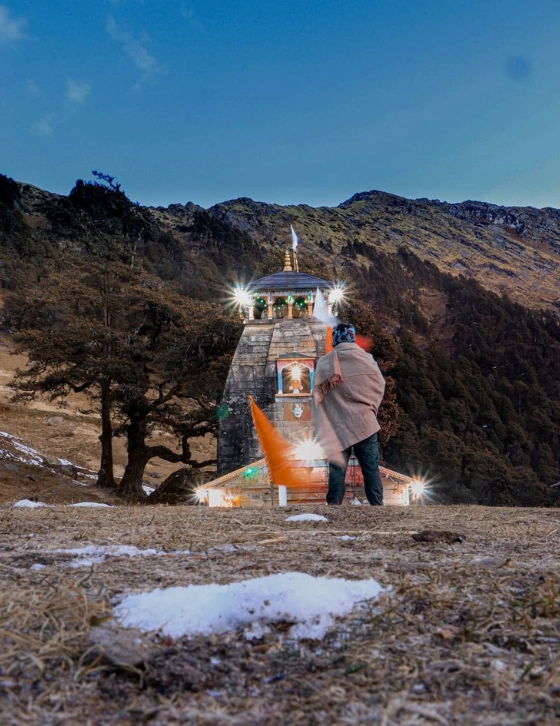
Madhyamaheshwar Temple is a high-altitude Hindu shrine in Rudraprayag district, Uttarakhand, and one of the five sacred Panch Kedar temples dedicated to Lord Shiva. Situated at 3,497 metres above sea level, the temple enshrines the navel (nabhi) of Shiva. Reaching it requires a 24-kilometre trek from Ransi village — a journey equally rewarding for pilgrims and trekkers. If you're planning a visit, this guide covers everything you need.
Madhyamaheshwar Temple — also known as Madmaheshwar, Madhmaheshwar, or Madhmeshwar Mahadev in different regional traditions — is one of the Panch Kedar, the five sacred shrines in the Garhwal Himalayas that together are believed to embody different parts of Lord Shiva's form. Madhyamaheshwar specifically enshrines the navel (nabhi) of Shiva.
The temple is managed by the Char Dham Devasthanam Board, the official body that oversees the Kedarnath, Badrinath, Gangotri, and Yamunotri shrines alongside the Panch Kedar temples. The madmaheshwar temple uttarakhand sits in the Kedarnath Wildlife Sanctuary, surrounded by some of the most ecologically sensitive alpine terrain in the state. According to Uttarakhand Tourism, the Panch Kedar circuit sees tens of thousands of pilgrims and trekkers annually, with Madhyamaheshwar being one of the less-crowded shrines — which is part of what makes it so special.
The story of Madhyamaheshwar begins in the Mahabharata. After the Kurukshetra war, the Pandavas sought the blessings of Lord Shiva to atone for the killing of their kin. Shiva, not wishing to grant them an audience, took the form of a bull (Nandi) and hid in the Garhwal hills. When the Pandavas tracked him down, the bull dove into the earth — but different parts of the body resurfaced at five locations. The hump reappeared at Kedarnath. The arms at Tungnath. The face at Rudranath. The hair and scalp at Kalpeshwar. And the navel — the sacred nabhi — surfaced here, at what we now call Madhyamaheshwar.
The Madhyamaheshwar Shivling is unlike the tall, smooth lingams you find in plains temples. It is wide, flat-topped, and almost organic in form — as if it genuinely grew from the alpine earth rather than being carved or placed. The surface is dark, worn smooth by centuries of abhishek with milk, honey, and sacred water. To stand before it is to understand, viscerally, why this shrine has drawn pilgrims for over a thousand years.
What most first-time pilgrims are surprised to find is that there is a second shrine above the main temple: Budha Madmaheshwar (also written as Buda Madmaheshwar, or Vriddha Madmaheshwar). This higher-altitude extension sits roughly 3 kilometres above the main temple and is considered especially auspicious — the ‘elder’ form of the deity. Serious yatris make the additional climb. The views from up there, on a clear day, will stay with you for the rest of your life. And isn’t that precisely the kind of detail that separates a pilgrimage from a visit?
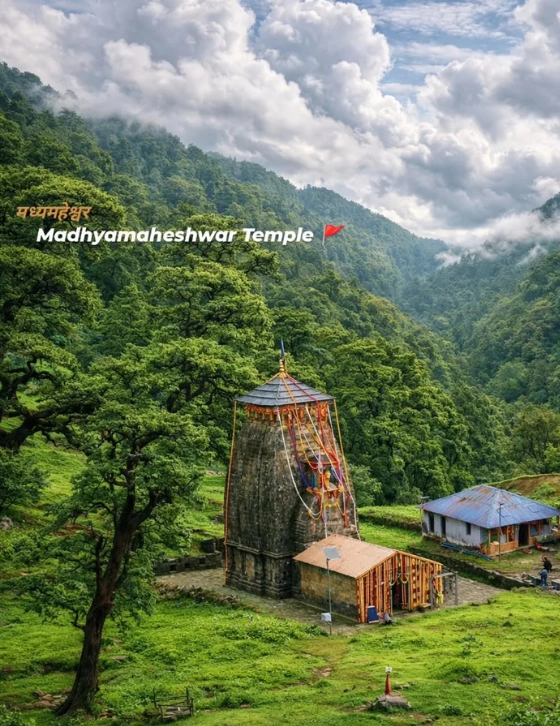
Madhyamaheshwar is located in the Rudraprayag district of Uttarakhand, deep in the Garhwal Himalayas. To be precise: the madhyamaheshwar temple trek rudraprayag uttarakhand sits within the Kedarnath Wildlife Sanctuary — a protected forest zone that also shields the trail from overdevelopment, keeping it genuinely wild.
The temple stands at 3,497 metres (11,473 feet) above sea level — high enough for the air to feel thin on your first morning, high enough for temperatures to drop sharply after sunset even in May. The nearest base village is Ransi (sometimes spelled Raunsi), from where the trek begins. The nearest staging town is Ukhimath, a small but important hill town that serves as the winter seat of the Kedarnath deity and makes an excellent overnight stop before you head to Ransi.
From Delhi, Madhyamaheshwar is approximately 430–450 km by road — a long drive but very doable over two days with an overnight halt at Rishikesh or Rudraprayag. Here's something that doesn't appear in most online guides: the road from Ukhimath to Ransi village is narrow and winding, and after heavy rains the last 8–10 km can be tricky even for experienced hill drivers. If you're self-driving from Delhi between July and September, check road conditions via the Uttarakhand Tourism helpline (1364) the morning before you set out.
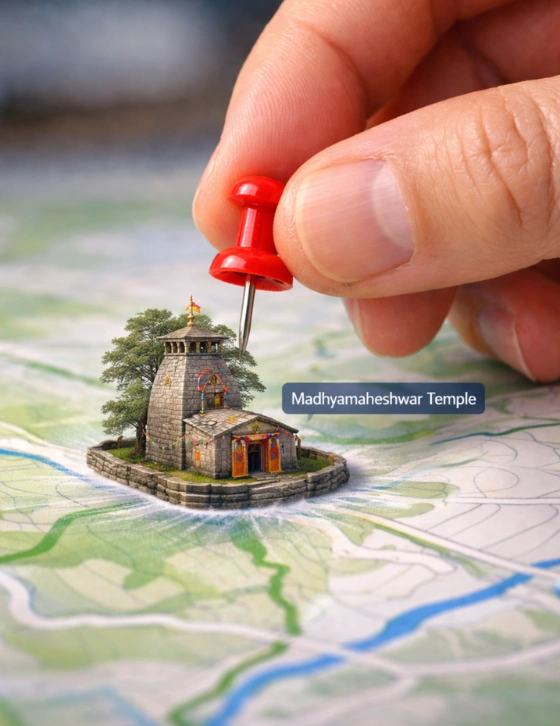
Madhyamaheshwar Temple stands at an altitude of 3,497 metres (11,473 feet) above sea level in the Rudraprayag district of Uttarakhand. At this elevation, temperatures at night can drop to near 0°C even in peak season (May–June), and the air holds roughly 35% less oxygen than at sea level. Trekkers arriving from plains cities should budget one acclimatisation night at Ukhimath or Ransi before attempting the final ascent.
Day by Day
Madhyamaheshwar Temple opens annually on Vaishakh Purnima — which typically falls in May — and closes on Bhai Dooj in October or November. The exact dates follow the Hindu calendar and are formally announced each year by the Char Dham Devasthanam Board. For madmaheshwar opening date 2026:
The temple has just opened, rhododendrons paint the hillsides red and pink, and the meadows around Madhyamaheshwar are at their greenest. Days are mild (12–18°C), nights are cold (3–7°C). This is the season for families, first-time pilgrims, and anyone who wants clear Himalayan skies. The post-opening first week sees a rush of devotees — if you prefer a quieter darshan, aim for the second or third week of May.
The monsoon clears, the grass turns golden, and the meadow takes on a quality that’s genuinely hard to describe without sounding like a tourism brochure — so I’ll just say: come in late September and see for yourself. Crowds are lower than in May–June, and visibility is exceptional.
The trail from Bantoli onward gets genuinely slippery during heavy rainfall. Leeches are a reality. Landslide risk on the road from Ukhimath to Ransi is real. Trek operators often advise against this window unless you’re experienced in monsoon trekking. Proceed only after checking conditions.
The temple is closed. Heavy snowfall makes the upper trail inaccessible. Not a period for visits.
The final approach is what gets people. You’ve been walking through forest for most of two days, and then the tree line gives way — and suddenly you’re standing at the edge of the Madhyamaheshwar bugyal, the high-altitude meadow that surrounds the temple. In May, it’s a carpet of green with patches of snow on the ridges above. In September, it’s golden and wide and surprisingly quiet, the sky impossibly blue at 3,497 metres.
The Madhyamaheshwar Shivling is housed in a simple stone temple — not ornate, not grand in the way plains temples are. That simplicity is the point. The abhishek here is unhurried; the Devasthanam Board’s priests conduct it without the rush you might experience at Kedarnath during peak season. First-time pilgrims should reach by the morning puja if possible — typically 6 AM — and carry milk, honey, or bel patra for the offering.
Above the main temple, visible from the meadow, is Vriddha (Budha) Madmaheshwar — roughly 3 km further up. Many pilgrims who make the extra climb describe it as the emotional peak of the entire yatra. Basic accommodation at the temple complex includes a Devasthanam Board dharmshala and a handful of simple guesthouses run by local families. Don’t expect hot showers or Wi-Fi — but do expect warm chai, a simple meal of dal-roti, and more stars than you’ve seen from any rooftop in Delhi or Mumbai.
Season Guide
With MadMaheshwar Trek : If you’d rather not handle the logistics yourself — booking taxis, finding accommodation at Ransi, hiring a local guide — MadMaheshwar Trek offers guided packages that include transport from Rishikesh, accommodation at every stopover, a local guide who knows the trail in every season, and all necessary permits. They’ve been running this specific trek for over 10 years. That kind of on-ground experience matters on a mountain trail.
From Ransi village, the trail to Madhyamaheshwar is approximately 24 km one way, typically covered over 2 days. The route passes through dense oak and rhododendron forest via Bantoli, opens into alpine meadows beyond Nala, and ends with a ridge walk that first reveals the temple and the meadow around it. The trail is well-defined but steep in sections — a moderate fitness level is sufficient if you’re not rushing.
Take NH-58 from Delhi toward Rishikesh (~240 km, 5–6 hours). From Rishikesh, continue to Rudraprayag (~140 km, 4 hours), then onward to Ukhimath (~30 km, 1 hour on a winding mountain road). From Ukhimath, a local cab or shared jeep covers the remaining 15–18 km to Ransi village, the trek’s starting point. Total road distance from Delhi: approximately 430–450 km.
The nearest major railheads are Haridwar and Rishikesh. Overnight trains from Delhi (NDLS, HNZ, or DLI stations) to Haridwar run daily — check IRCTC for availability. From Haridwar, hire a cab or take a shared taxi toward Rudraprayag.
The closest airport is Jolly Grant Airport, Dehradun (~210 km from Ukhimath). IndiGo and Air India operate regular flights from Delhi, Mumbai, and Bengaluru. Pre-book a cab from the airport to Ukhimath — it’s a 4–5 hour drive through the hills.
Fewer pilgrims, more intact trail, and stricter environmental controls than most Uttarakhand treks. If you want the Himalayan experience without the Kedarnath crowd, Madhyamaheshwar gives you exactly that.
What to Carry
Target pack weight: 8–12 kg. Your guide and porter carry group equipment. You carry personal gear.
❌ Do Not Carry
Alcohol (altitude + alcohol = increased AMS risk and poor judgment). Single-use plastic bottles (banned in Kedarnath Wildlife Sanctuary — bring a refillable bottle). Heavy camera tripods or body-only DSLR kits. Extra footwear beyond camp sandals. Anything you will not use. Every kilogram over 12 kg adds measurable difficulty to the Day 2 climb.
Frequently Asked Questions
Everything first-time trekkers ask us before booking. If your question isn’t answered here, WhatsApp us — we reply within 2 hours.
Madhyamaheshwar Temple is a sacred Hindu shrine dedicated to Lord Shiva, situated at 3,497 metres in Rudraprayag district, Uttarakhand. It is one of the five Panch Kedar temples and enshrines the navel (nabhi) of Shiva, according to the Mahabharata legend. The temple is accessible via a 24-km trek from Ransi village and remains open from May to October/November each year.
The madmaheshwar height is 3,497 metres (11,473 feet) above sea level. At this madmaheshwar altitude, nighttime temperatures can drop close to 0°C even in summer. Trekkers from plains cities are advised to spend a night at Ukhimath or Ransi for acclimatisation before the final day’s ascent to avoid altitude sickness.
Madmaheshwar Temple opens each year on Vaishakh Purnima, which typically falls in May — the exact 2026 date will be announced by the Char Dham Devasthanam Board closer to the season. The temple closes on Bhai Dooj in October or November. Register your visit in advance at registrationandtouristcare.uk.gov.in, as registration is mandatory for all Panch Kedar shrines.
Budha Madmaheshwar — also written as Buda Madmaheshwar or Vriddha Madmaheshwar — is a secondary shrine situated approximately 3 km above the main Madhyamaheshwar temple, at a higher altitude of roughly 3,700 metres. Dedicated to the ‘elder’ form of Shiva, it is considered especially auspicious. Many pilgrims on the Panch Kedar yatra make this additional climb on the second day.
From Delhi, take an overnight train to Haridwar or Rishikesh (~240 km), then travel by road via Rudraprayag to Ukhimath (~170 km more), and finally reach Ransi village by local cab (~15 km). The trek from Ransi to the temple is 24 km one way, done over 2 days. MadMaheshwar Trek offers all-inclusive guided packages from Rishikesh if you prefer not to manage logistics independently.
The best time to visit Madhyamaheshwar is May–June and September–October. May offers blooming rhododendrons and the freshly opened temple, while September–October brings golden meadows, clear skies, and thinner crowds. July–August is monsoon season — the trail is slippery and road conditions can be hazardous. The temple closes for winter after Bhai Dooj and does not reopen until the following May.
